
Why You Should Choose CNC for Your Built-In Furniture Today
The Key Differences That Make It Better Than On-Site Work
When people think of built-in furniture, many imagine a long, drawn-out process — wood dust everywhere, and the lingering smell of paint or thinner inside their home. Today, manufacturing technology has stepped in to solve these problems, particularly through the use of CNC (Computer Numerical Control) machines in the production process.
In this article, G-Code Cabinetry takes a deep dive into how CNC-based built-in furniture production differs from traditional on-site cutting or “frame construction” methods, and why this approach has become the new standard that delivers both quality and budget efficiency for modern homes.
1. Significantly Less Dust and Pollution On-Site
Traditional built-in work requires carpenters to cut, assemble, and paint primarily on-site, inevitably generating large amounts of dust and requiring lengthy installation times. In contrast, CNC systems pre-cut and prepare all components at the factory in an organized manner. While some minor trimming may still be needed on-site to match the actual slopes of floors or walls for a perfect fit, the amount of on-site dust and installation time is noticeably reduced compared to doing all the cutting on-site.
2. Solid Materials, More Durable Than “Frame Construction”
Traditional built-in methods often use a technique called “frame construction” — assembling a skeleton from wood joists and covering the front and back with thin plywood. This typically leaves hollow spaces inside, limiting load capacity and risking collapse if impacted. For CNC work, we use full-density panel materials as standard, such as HMR (High Moisture Resistance) board, which excels in strength and moisture resistance. This ensures cabinet structures are solid, not hollow, with a much longer service life.
3. Unlocking Melamine’s Potential — Budget-Friendly Without Chipped Edges
Melamine-coated board is highly popular due to its affordable cost while maintaining strength and durability, making it ideal for internal cabinet structures to keep budgets in check. Using it for both the structure and door panels can save even more.
However, the limitation of melamine is that when cut by hand or with general-purpose saws on-site, the melamine surface tends to chip and crack — resulting in unsightly edges. CNC machines solve this problem completely. With specialized blade speeds and cutting tools, they produce clean, crisp cuts with smooth edges and no surface cracking.
4. No More Peeling Surfaces or Cracked Edges — Thanks to Press and Edge Banding Systems
A classic problem with traditional built-in work is laminate peeling off, or edge joints where carpenters use putty and paint — which over time tends to crack along the seams. In our production process, laminate surfaces are applied using a Press machine that provides consistent pressure, effectively preventing peeling. Additionally, Edge Banding is done with specialized machinery that works faster and more precisely than manual application, ensuring smooth, seamless joints and eliminating edge cracking issues.
5. Consistent Quality Control and Production Standards
CNC systems work directly from 3D files and command codes, ensuring every component is produced to exact design specifications. This eliminates measurement errors that can occur with manual cutting. The consistency in production ensures that joints and drawers fit together perfectly, while also enabling the production of designs requiring high precision with maximum efficiency.
 CONCLUSION
Additional Summary
That said, the interior and built-in furniture industry continues to debate whether “CNC work” or “frame construction” is the better approach. It wouldn’t be entirely fair to claim CNC is superior in every aspect, as traditional frame construction still has its strengths and can effectively address the constraints of certain types of projects.
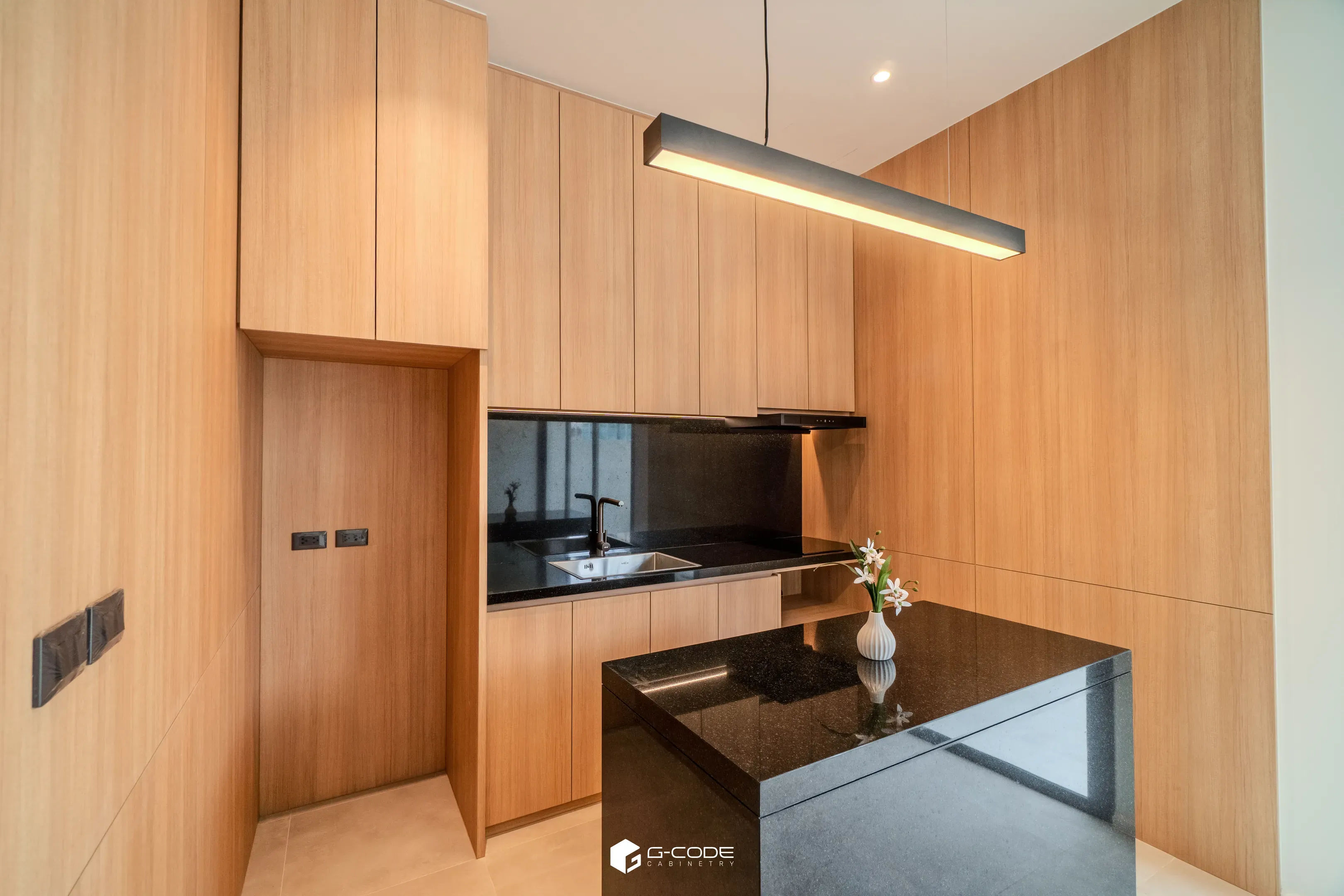
Nevertheless, it’s undeniable that adopting CNC systems for built-in furniture production represents a new standard that solves many classic problems — from reducing on-site time and pollution, to using solid full-panel materials, achieving clean surface finishing and edge banding, maintaining controllable precision, and managing budgets effectively.
If you’re planning built-in furniture that prioritizes precision, design, budget, and long-term durability, G-Code Cabinetry is here as an option to transform your space with modern manufacturing standards.