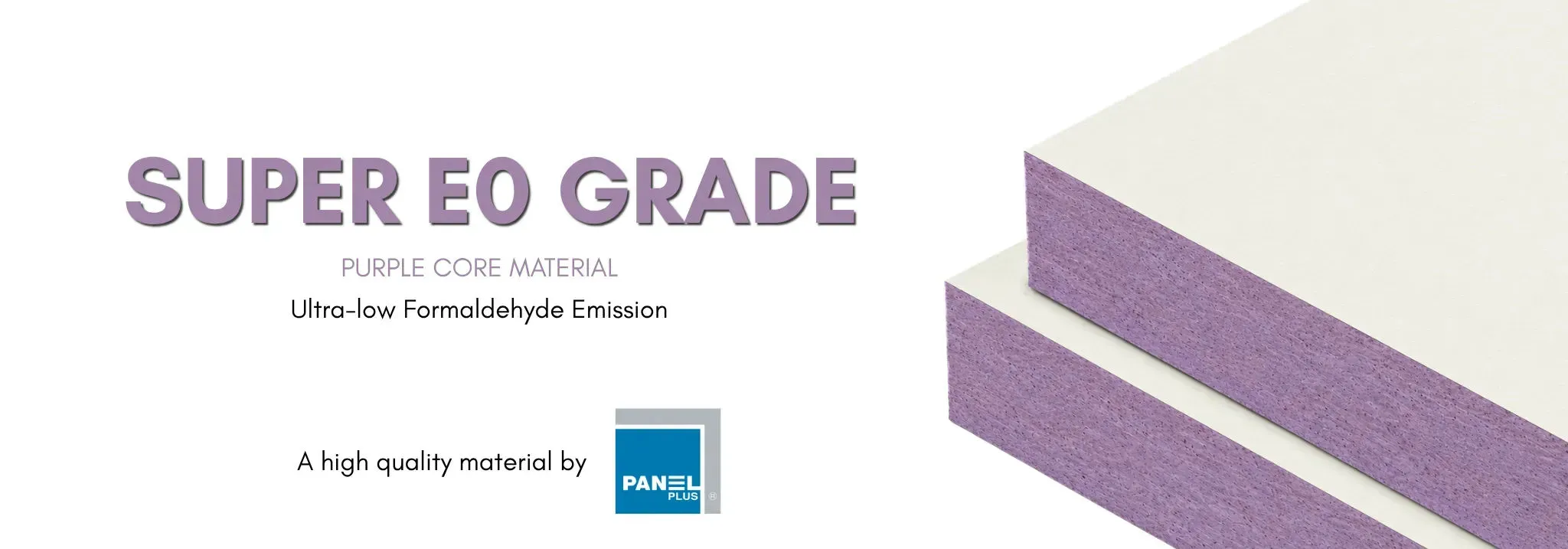
What Is Super E0 “Purple Core” Board? Why a Purple Core Changes the Air Standard in Your Home
Ever noticed that when you open a freshly installed built-in cabinet, a “new cabinet smell” drifts out? Many people assume it’s the wood, the lacquer, or just that new-product smell that will fade on its own. The truth is that part of that smell is formaldehyde — a compound in the glue that binds engineered board together. And it doesn’t evaporate in a week; it keeps releasing for years, especially in today’s homes and condos where the air conditioning runs almost constantly and the air barely circulates.
2026 brought a genuinely interesting development to the board industry here in Thailand: Panel Plus launched “Purple Core,” a Super E-Zero grade board — the first in the country — at the Thematic Pavilion of Architect’26. In this article, G-CODE Cabinetry walks you through what it is, how it differs from the board most people use, and whether it’s worth choosing for your built-in project.
1. Where Does the Formaldehyde in Built-in Furniture Come From?
Almost every board used for built-in furniture — particleboard, MDF, HMR, plywood — isn’t solid timber from a tree. It’s wood fibres or chips pressed together with glue and hot-pressed into sheets.
The adhesives used across most of the industry are the UF (Urea Formaldehyde) and MUF (Melamine Urea Formaldehyde) families, both of which contain formaldehyde. Once the board becomes a cabinet sitting in a room, that compound slowly off-gasses into the air.
Why it deserves your attention:
- A sealed, air-conditioned room accumulates volatile compounds far more than a well-ventilated one
- Full-room built-ins use a lot of board, so the surface area releasing the compound scales up with it
- Young children, the elderly, allergy-prone people and pets are usually the first in the house to feel the effects
Put simply: the more built-ins your home has, the more the board grade you choose affects the air you breathe every day.
2. How Do E2 / E1 / E0 / Super E0 Differ?
The “E grade” is a classification system based on how much formaldehyde a board releases. The lower the number, the lower the emission — and the safer it is for the people living with it.
| Grade | Formaldehyde emission | Typically found in |
|---|---|---|
| E2 | High | Cheap board, work with no material spec control |
| E1 | Low (minimum acceptable standard for furniture) | Standard-grade board sold across the market |
| E0 | Very low | Health-focused projects, hospital work |
| Super E0 (SE0) | Lowest of any engineered board | Premium board such as Purple Core |
The key point for homeowners: most board sold on the market is E1. It passes the standard and performs fine — it isn’t bad material. But “passes the standard” and “the best available” are two different things — and that difference shows most clearly in a child’s bedroom or a room with the air conditioning on all day.
3. What Is “Purple Core”? Why Is the Core Purple?
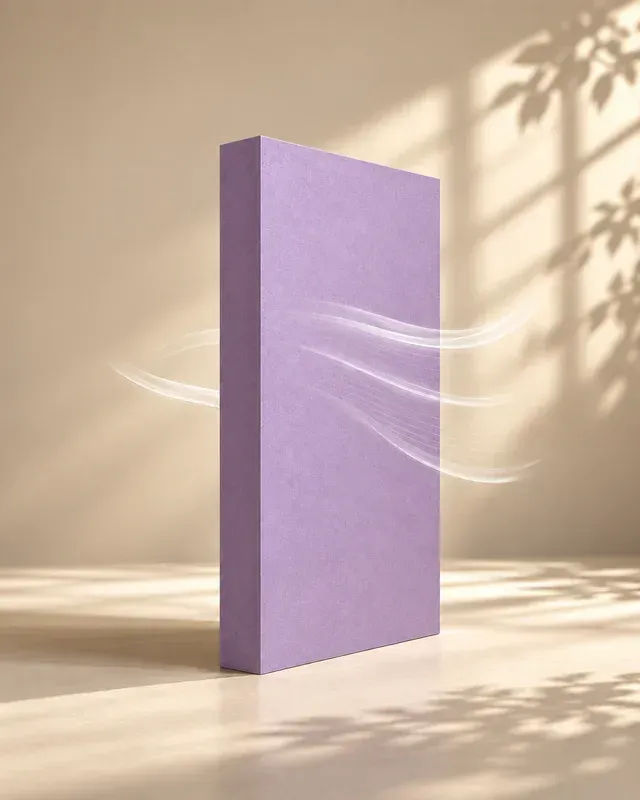
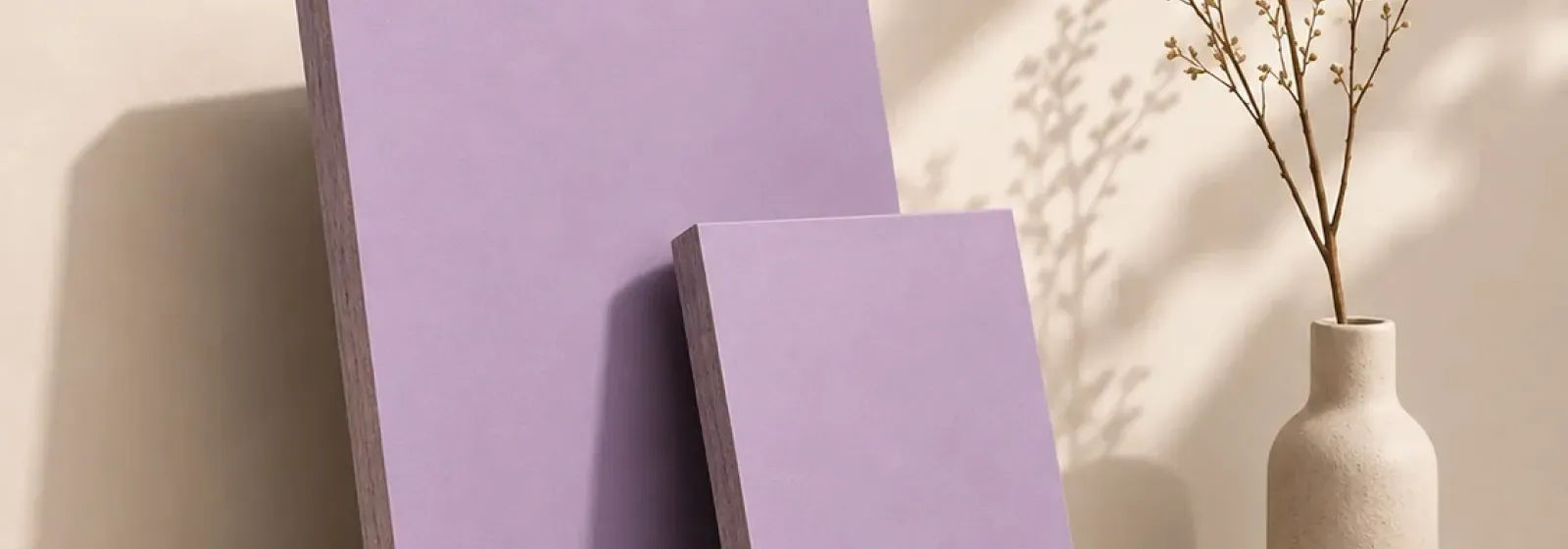
Purple Core is a Super E-Zero grade board from Panel Plus, launched this year. The most memorable thing about it: the inner core is dyed purple.
The colour isn’t decorative. It’s a grade identifier, a convention used across the board industry — much like the green core many people recognise on moisture-resistant board. Using colour as the marker brings real advantages:
- Verifiable by eye — a homeowner can look at a panel edge or a cut and know instantly whether it’s the real thing
- Hard to swap mid-project — you no longer have to take the quotation’s word for it
- Checkable on site — when the installers arrive, you can walk around and inspect the panel edges yourself
For us as a manufacturer, this is an advantage that’s hard to overstate. It turns “material grade” into something that can be proven right in front of the client, instead of a line in a document they have no way to verify.
4. The Standards Behind Purple Core
Panel Plus rates Purple Core’s formaldehyde emission at ≤ 0.03 ppm, backed by two certifications:
🔹 F★★★★ (F-Four Star) — Japan
The highest tier of Japan’s standard for engineered wood. In Japan, F★★★★ materials are the only group permitted for building use with no restriction on where they can be installed — making it one of the strictest benchmarks in the world for this category.
🔹 Sensitive Choice — National Asthma Council Australia
An approval programme run by Australia’s National Asthma Council, which selects products suited to people sensitive to airborne triggers. What makes it interesting is that it isn’t an engineering standard — it’s an endorsement from the perspective of “the person living in that room.”
5. Which Projects Suit Purple Core?
A strong fit for:
- Children’s bedrooms and playrooms — children spend long hours in their rooms and breathe faster than adults relative to body weight
- The master bedroom — we spend 7-8 hours a day there with the door shut and the air conditioning on
- Homes with elderly residents, allergy sufferers or pets
- Condos and rooms with limited ventilation — the smaller and more sealed the room, the higher the ratio of board surface to air volume
- Homes with built-ins throughout — the amount of board is many times greater than a single-spot job
Possibly not necessary yet:
- Storage cabinets in open, well-ventilated spaces — garages, balconies, airy storerooms
- Tightly budgeted work in spaces nobody occupies regularly
6. What to Know Before You Decide
Things to watch:
- It costs more than standard-grade board — this is a premium material with a higher cost per sheet than ordinary E1. Discuss the budget early: whole house, or only the rooms that matter most?
- “Low formaldehyde” and “moisture resistant” are different properties — don’t confuse the two. Bathrooms and under-sink cabinets still need material chosen by moisture level first (see Choose the Right Material from the Start)
- Board is only part of the equation — the surface finish, the edge-banding glue and on-site paintwork release volatile compounds too. A high-grade board should come with sensibly chosen companion materials
- Always ask to see the real thing — if a contractor says they’re using Super E0, ask to see a panel edge or an offcut. Purple is the clearest answer there is
 CONCLUSION
💬 Conclusion: Not Every Room Needs It — But Every Home Deserves the Choice
| If you’re… | Our recommendation |
|---|---|
| Building bedroom built-ins, especially a child’s room | The single most worthwhile place to upgrade to Super E0 |
| Fitting out a whole house or condo | Use it throughout, and match the edge-banding materials to it |
| Only doing storage cabinets or open-air spaces | Standard-grade board still serves you well |
| Living with someone especially sensitive to air | Start with the rooms they spend the most time in, then expand from there |
Choosing the best material doesn’t mean using the most expensive option everywhere. It means knowing where the extra spend goes and what you get back — and the air your family breathes every day is one of the places where paying more has the clearest justification.
G-CODE Cabinetry now offers Super E0 Purple Core board for built-in work. Our team is happy to price the difference for your actual project, so you can decide whether to upgrade the whole home or just the rooms that matter most to your family.